
Jump to publications by topic

Research articles, reviews and preprints

Orientation and Navigation in migratory Lepidoptera

The Role of Magnetic and Celestial Cues in Orientation and Navigation of Red Underwing (Catocala nupta), a European Migratory Moth (2026)
Read more – bioRxiv
type: Research article
status: in preparation
Not All Butterflies Are Monarchs: Compass Systems in the Red Admiral (Vanessa atalanta), a European Diurnal Migrant (2025)
Read more – bioRxiv
type: Research article
status: under review in a journal
Orientation tests and long-term movement phenology establish the red admiral Vanessa atalanta as an applicable model for navigation research in migratory butterflies (2023)
Read more – bioRxiv
type: Research article
status: under review in a journal

Orientation mechanisms in migratory bids

Migratory birds are able to choose the appropriate migratory direction under dim yellow narrowband light (2023)
Read more – Proceedings of Royal Society B
type: Research article
status: published
Early version/preprint: see here https://www.biorxiv.org/content/10.1101/2023.01.13.523666v2

Sensitivity threshold of avian magnetic compass to oscillating magnetic field is species-specific (2023)
Read more – Behavioral Ecology and Sociobiology
type: Research article
status: published

Oscillating magnetic field does not disrupt orientation in the presence of stellar cues in an avian migrant (2023)
Read more – Journal of Ornithology
type: Research article
status: published
Ontogeny of the star compass in birds: pied flycatchers (Ficedula hypoleuca) can establish the star compass in spring (2021)
Read more – Journal of Experimental Biology
type: Research article
status: published
Magnetic compass of garden warblers is not affected by oscillating magnetic fields applied to their eyes (2020)
Read more – Scientific Reports
type: Research article
status: published

Very weak oscillating magnetic field disrupts the magnetic compass of songbird migrants (2017)
Read more – Journal of Royal Society Interface
status: published

Further evidence of a time-independent stellar compass in a night-migrating songbird (2017)
Read more – Behavioral Ecology and Sociobiology
type: Research article
status: published

Magnetic orientation of garden warblers (Sylvia borin) under 1.4 MHz radiofrequency magnetic field (2014)
Read more – Journal of Royal Society Interface
type: Research article
status: published
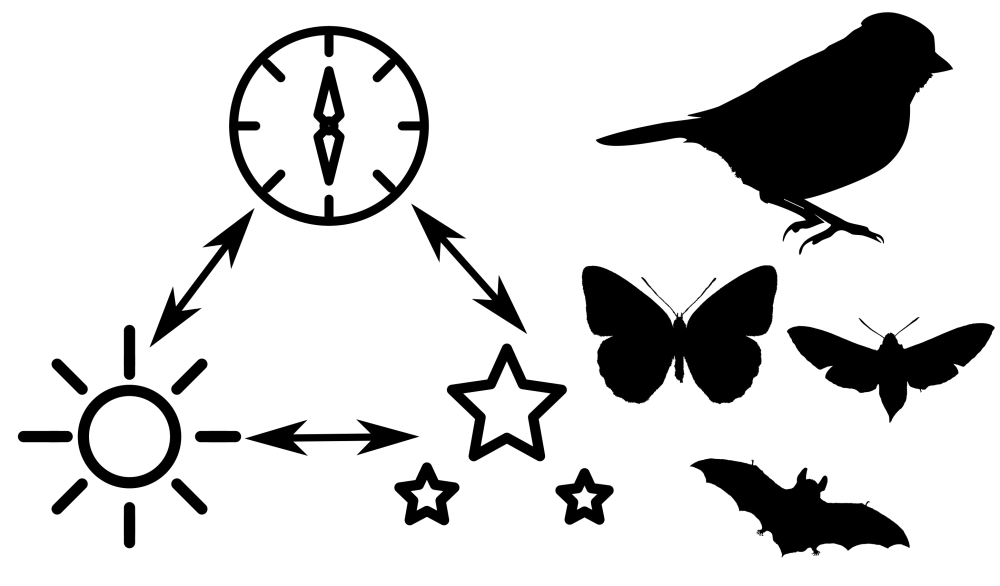
Multi-cue integration and compass calibration in migratory animals
Access to the sky near the horizon and stars does not play a crucial role in compass calibration of European songbird migrants (2022)
Read more – Journal of Experimental Biology
type: Research article
status: published
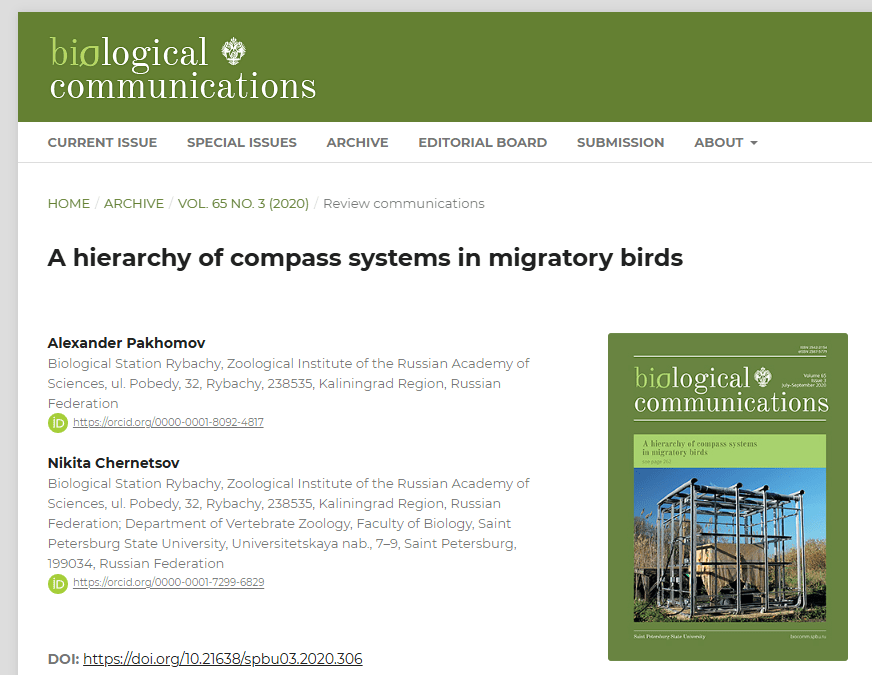
A hierarchy of compass systems in migratory birds (2020) – review
Read more – Biological Communications
type: Review
status: published
P.S. Our experimental setup for virtual magnetic displacements and compass calibration experiments is on the cover of this issue.
Early evening activity of migratory Garden Warbler Sylvia borin: compass calibration activity? (2014)
Read more – Journal of Ornithology
type: Research article
status: published

Navigation in migratory birds

Magnetic orientation of marsh warblers (Acrocephalus palustris) and spotted flycatchers (Muscicapa striata) after simulated crossing of the magnetic equator (2025)
Read more – Journal of Experimental Biology
type: Research article
status: published
No evidence for the use of magnetic declination for migratory navigation in two songbird species (2020)
Read more – PLOS ONE
type: Research article
status: published

Magnetic map navigation requires input from the trigeminal nerve in a migratory songbird (2018)
Read more – Scientific Reports
type: Research article
status: published

Migratory Eurasian reed warblers can use magnetic declination to solve the longitude problem (2017)
Read more – Current Biology
type: Research article
status: published

Eurasian reed warblers compensate for virtual magnetic displacement (2015)
Read more – Current Biology
type: Research article
status: published

Orientation and Navigation in migratory bats
Birds are easier to trick: an effect of magnetic field manipulation on migratory orientation of Nathusius’ pipistrelle in the circular release box (2023)
Read more – bioRxiv
type: Research article
status: postponed

Outreach activities and media coverage of our research and collaborative studies
Declination article, Current Biology 2017
Forbes (English)
PhysOrg (English)
Times (English)
The Conversation (English)
The Telegraph (English)
Other media
Trigeminal nerve and magnetic map (Russian)
Parallel Worlds (Russian)
How birds learn to use the stars to find their way home (Russian)
Navigation of juvenile songbird migrants (Russian)
 Animal Navigation Lab