
Brief info
model species
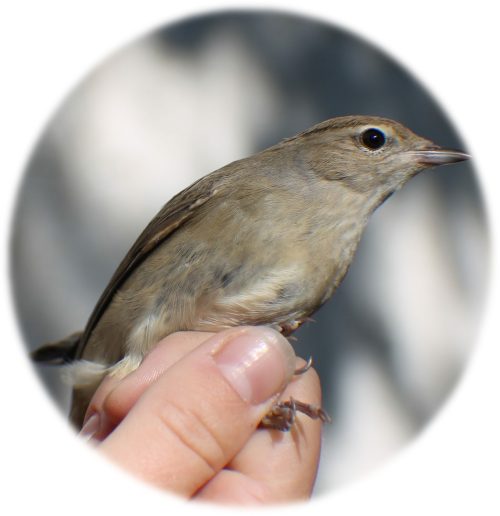
Garden warbler
Sylvia borin
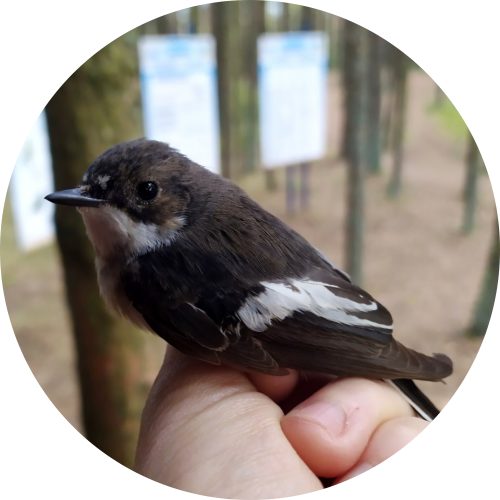
Pied flycatcher
Ficedula hypoleuca
Project PI
OMF projects:
Dr Nikita Chernetsov,
Dr Julia Bojarinova,
DR Kirill Kavokin
Light projects:
Dr Alexander Pakhomov
Collaborators
Background and Knowledge gap
Migratory birds are known to obtain information from the geomagnetic field to perform orientation and navigation tasks. While the physiological mechanisms underlying the magnetic sense remain uncertain, it is widely accepted that birds rely on two distinct magnetoreception systems: a chemical magnetoreceptor located in their eyes and a magnetite-based receptor, likely situated in the upper beak. The chemical magnetoreception system is thought to function as a magnetic compass for orientation tasks, while the iron-based magnetoreceptor may contribute to the magnetic map used in navigation. The most well-developed and widely discussed hypothesis suggests that the magnetic sense is based on spin-dependent photochemical reactions (the Radical Pair Mechanism). According to this theory, oscillating magnetic fields (OMFs) can destroy the ability to orient using the magnetic compass.
Our plans
In this project, we study how 1) oscillating magnetic fields (OMFs) with varying frequencies and amplitudes and 2) the spectral composition and intensity of light influence the magnetic orientation of birds in behavioural experiments, aiming to uncover the mechanisms underlying avian magnetic orientation.
Our discoveries
Our experimental setups
Key papers (click to expand):
Funding:
Type: Research Grant
Funder: Russian Science Foundation
Date: 2024 – 2026
Project: Magnetic compass and magnetic map in birds and amphibians.
PI: Nikita Chernetsov
Total fund: 77000€/yearType: Research Grant
Funder: Russian Foundation for Basic Research
Date: 2019 – 2020
Project: Light-dependent magnetoreception in songbird migrants: true or false?
PI: Alexander Pakhomov
Total fund: 48000 €/3 yearsType: Research Grant
Funder: Russian Science Foundation
Date: 2016 – 2020
Project: A mechanism of magnetic compass in migratory birds.
PI: Nikita Chernetsov
Total fund: 86000€/yearType: Research Grant
Funder: Russian Foundation for Basic Research
Date: 2015 – 2017
Project: Impact of oscillating magnetic fields of different frequency on orientation behaviour in passerines
PI: Nikita Chernetsov
Total fund: 10000€/yearType: Research Grant
Funder: Scientific program of SPbSC RAS
Date: 2014
Project: A mechanism of magnetic compass in migratory birds.
PI: Nikita Chernetsov
Total fund: 3000€
 Animal Navigation Lab