A list of main components, scripts, 3d printing/laser cutting files, instructions
A brief introduction
This version of flight simulators allow researchers to study how moths select and maintain a flight direction under different sensory conditions. It was created by Barrie Frost and researchers from Lund University (Erick Warrant, David Dreyer). This simulator retains the basic principle established by Mouritsen and Frost for monarch butterflies: a tethered insect rotates freely in the horizontal plane while an optical encoder continuously records its chosen heading.
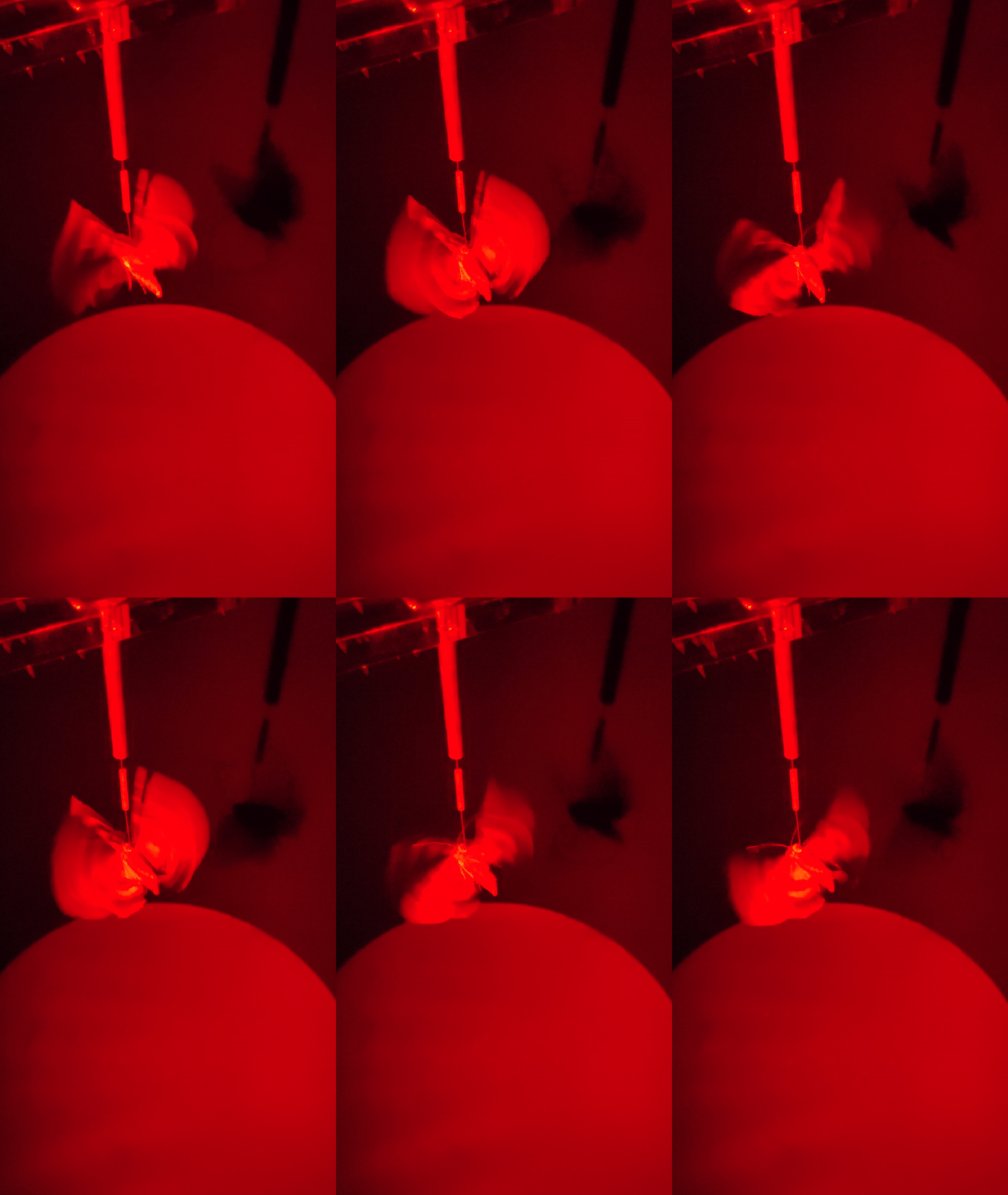
The main technical addition is closed-loop projected optic flow. In the original monarch simulator, gentle upward airflow stimulated sustained flight. This nocturnal setup also provides visual motion beneath the moth: the projected image moves from head to tail, and its direction updates whenever the animal turns. This creates visual feedback corresponding to forward movement and is intended to support sustained tethered flight. This adaptation follows the moth-simulator approach described by Dreyer and colleagues.
A design of our flight simulator
Guides:
- How to create classical version of a flight simulator:
A behavioral assay to test sensory-cue-guided oriented flight in monarch butterflies under controlled conditions - How to use a flight simulator to study migratory insects:
A Guide for Using Flight Simulators to Study the Sensory Basis of Long-Distance Migration in Insects - Non-invasive tethering technique:
Assaying lepidopteran flight directionality with non-invasive methods that permit repeated use and release after testing
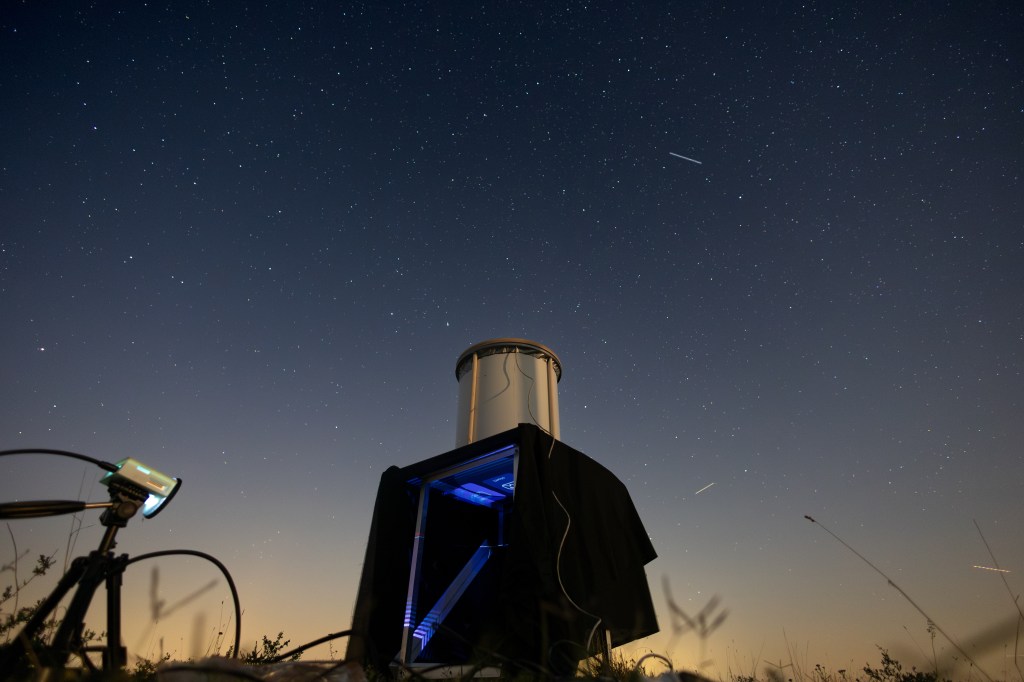
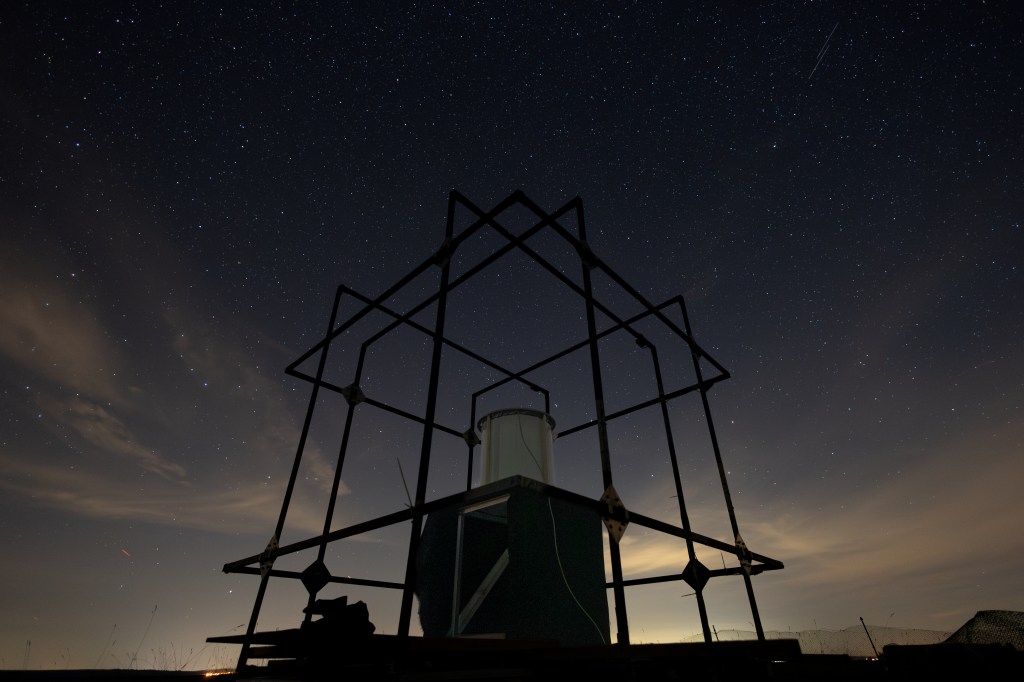
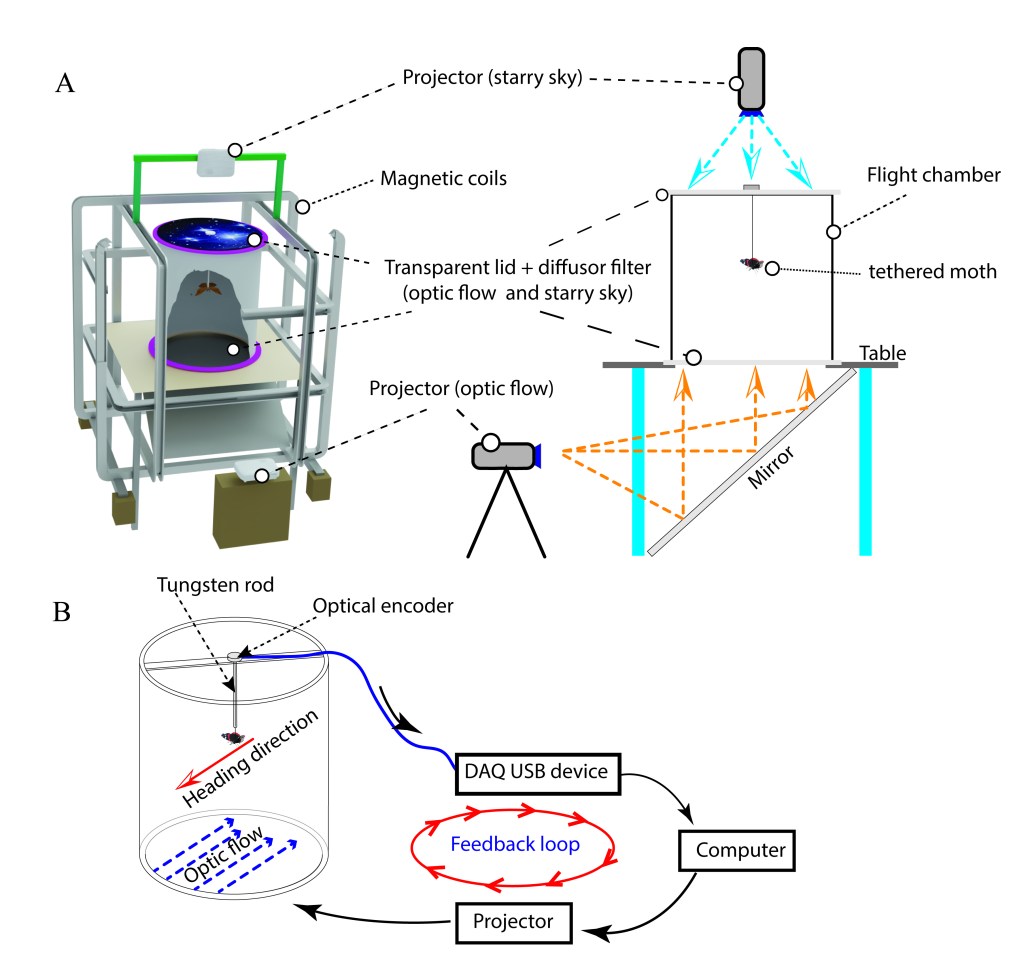
Our modified flight simulator combines a flight chamber, an optical direction-recording system and projected optic flow. We used this setup to investigate the roles of celestial and magnetic information in the orientation and navigation of the red underwing moth, Catocala nupta, during nocturnal migration (see here).
A Flight Chamber
The flight chamber is a plastic cylinder 45 cm in diameter and 50 cm high, mounted vertically on a supporting table. PVC, aluminium and PETG components are used to minimise interference with the experimental magnetic field. A black curtain lines the chamber to reduce reflections and provide a uniform visual background.
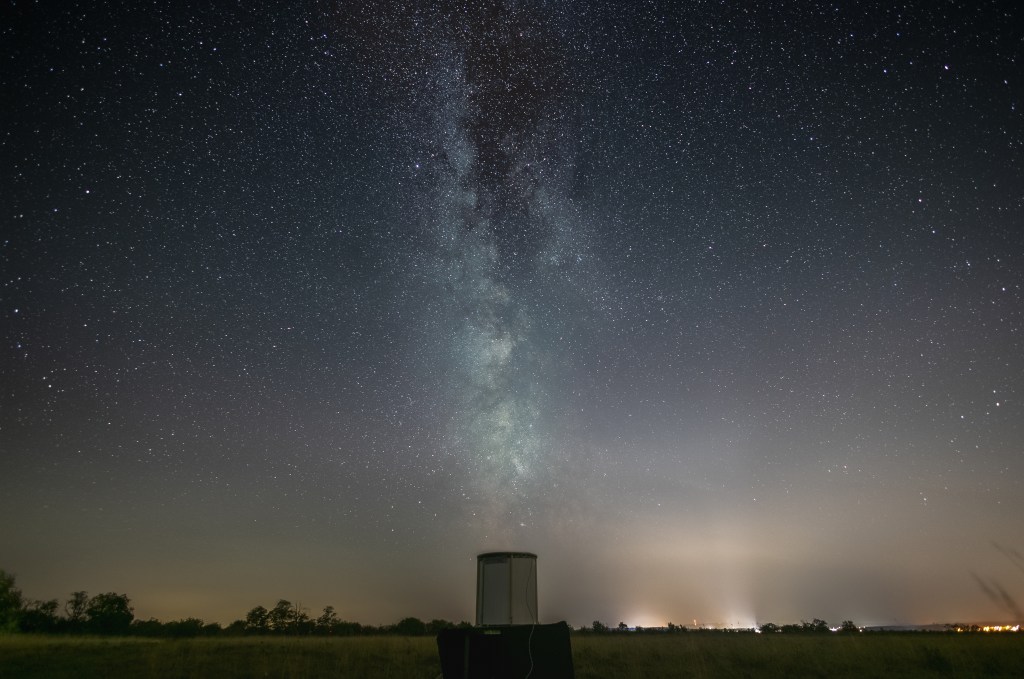
An acrylic bar above the chamber supports an optical encoder and a fine tungsten rod, 11 cm long and 0.5 mm in diameter. A small tether attached to the moth’s thorax connects to this rod, allowing the animal to fly and rotate through 360°. The open top provides access to the natural night sky within an approximately 120° viewing angle.
Direction Recording System
A miniature optical encoder measures rotation of the rod and records the moth’s heading. A data-acquisition device connects the encoder to a laptop, where observations are saved as angle–timestamp pairs.
A miniature optical encoder (for example, US Digital) continuously records the rotations of the tungsten rod carrying a tethered insect (0–360°). Within the simulator, attached insects could freely rotate in the horizontal plane, and their headings (azimuths relative to magnetic North) are measured with different resolution (1- 3°, depending on an encoder model) and frequency (samples per sec, usually 5Hz or 200 ms for each sample). The encoder is connected to a laptop via a data acquisition (DAQ) device, and the data is stored as angle–timestamp pairs in a .txt file.
Closed-loop optic flow
A portable projector presents dim moving imagery beneath the moth (see Figure 1B). Its beam passes through a 45° mirror onto a diffusing screen, while neutral-density filters reduce brightness to the level used in the nocturnal experiments.
Custom-written software links the projected movement to the encoder readings. Whenever the moth turns, the image movement changes accordingly, remaining directed from its head towards its tail. This closed-loop arrangement provides visual motion feedback intended to support sustained tethered flight. A ventilated, 3D-printed enclosure around the projector limits stray light.
Related research
Pakhomov, A., Dreyer, D., Zechmeister, T., Mouritsen, H. and Kishkinev, D. (2026). The Role of Magnetic and Celestial Cues in Orientation and Navigation of Red Underwing (Catocala nupta), a European Migratory Moth. bioRxiv preprint. Read the preprint.